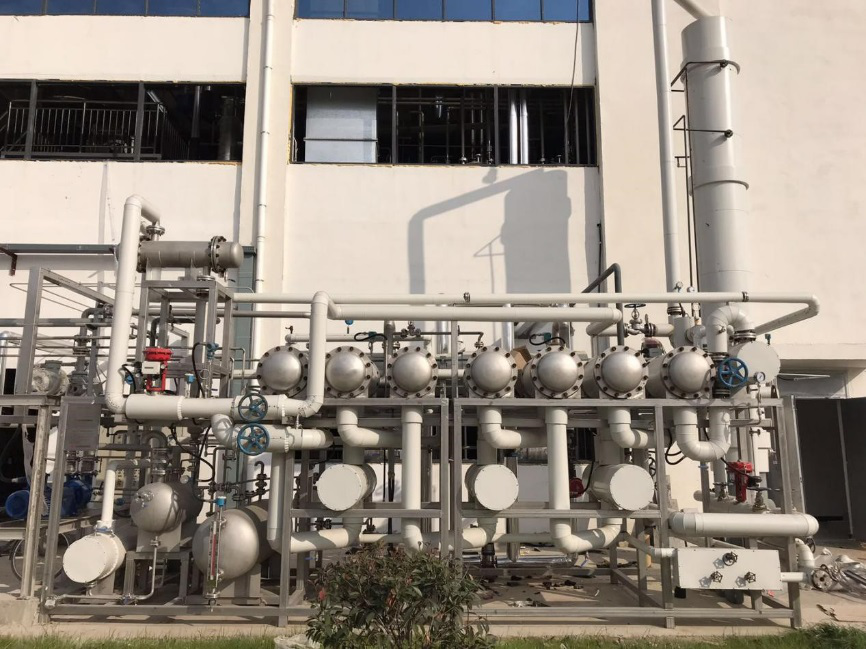
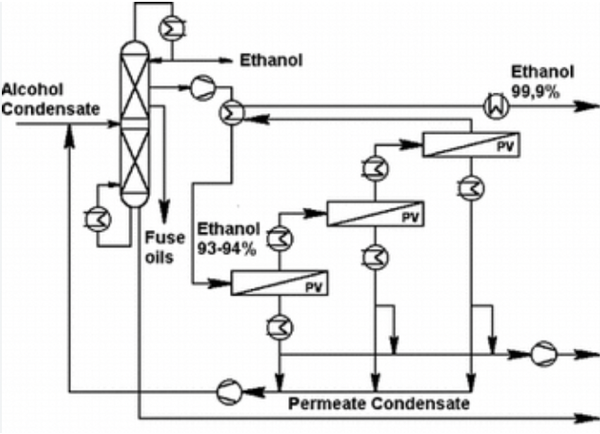
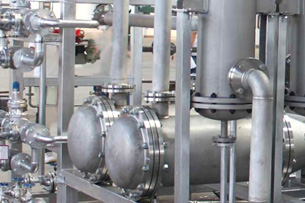
Ethanol (EtOH) is one of the most widely used organic solvents and an important chemical raw material in industry. In many production processes, ethanol needs to be dehydrated and purified to meet the requirements of solvent recovery, fine chemical manufacturing, and fuel ethanol applications. For ethanol, dehydration is not a simple distillation task, but a typical azeotropic separation challenge. Ethanol and water form an azeotrope under atmospheric pressure, with an azeotropic composition of about 95.6 wt% ethanol / 4.4 wt% water. This means that when the mixture approaches this composition, the purification efficiency of conventional distillation drops significantly, making it difficult to produce high-purity anhydrous ethanol by ordinary distillation alone. For this reason, ethanol dehydration has long been one of the most typical and mature applications of membrane separation, especially hydrophilic pervaporation membranes. The working principle of pervaporation is that the feed enters the membrane system in the liquid phase and contacts the selective layer on one side of the membrane. Because water and ethanol have different solubility and diffusion rates within the membrane, water is preferentially transported through the membrane. On the permeate side, the penetrated component is usually removed in vapor form by vacuum or sweeping gas. In this way, the water content in the ethanol stream is continuously reduced, achieving deep dehydration. Unlike distillation, which depends on volatility differences, pervaporation is based on selective mass transfer through the membrane, making it especially suitable for azeotropic systems such as ethanol-water mixtures.
In industrial processes, pervaporation membranes are usually not intended to replace the upstream distillation section entirely, but rather to serve as a final dehydration unit after distillation. The upstream distillation first concentrates ethanol to near the azeotropic composition, and the downstream pervaporation membrane then removes the remaining water, further increasing the product purity to the level required for anhydrous ethanol or fuel-grade ethanol. For fuel ethanol, the target purity is commonly 99.5 wt% or higher.
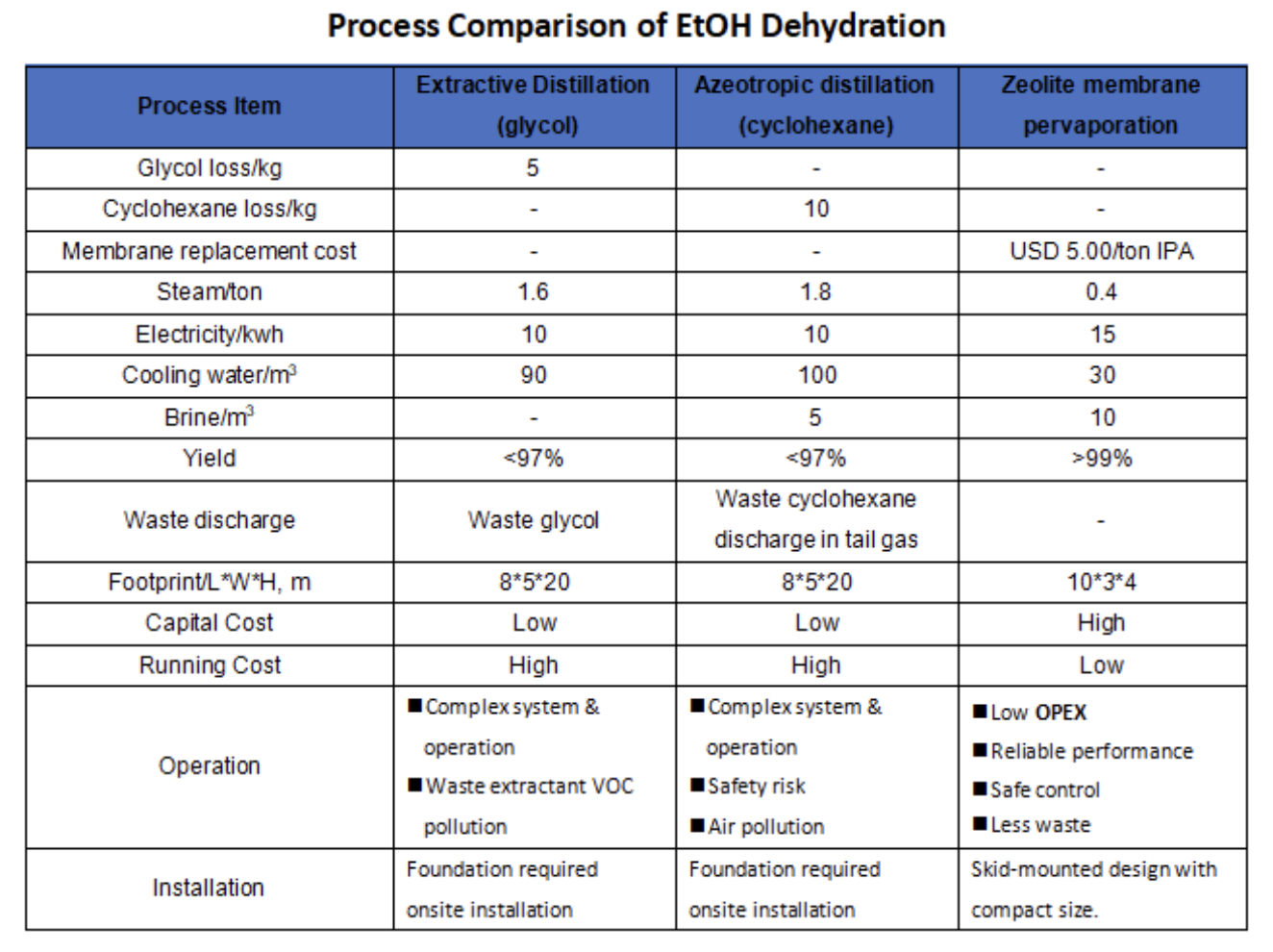
From an engineering point of view, the value of pervaporation membrane in EtOH dehydration is mainly reflected in the following aspects:
Overcoming the azeotropic limitation
Conventional distillation faces a clear bottleneck around 95.6 wt% ethanol, while pervaporation does not rely on vapor-liquid equilibrium and can therefore continue removing water to further purify ethanol.
Suitable for deep dehydration
When the water content becomes very low, removing trace water by distillation usually requires high energy input. Pervaporation removes water through selective membrane transport and is therefore more effective in the final dehydration stage.
Easy process integration
By combining distillation + pervaporation, the burden on complex dehydration units can be reduced, making the overall process more compact while balancing product purity and operating efficiency.
Good operational flexibility
The dehydration performance can be adjusted through parameters such as membrane area, operating temperature, feed composition, flow rate, and permeate-side pressure. This makes the technology well suited for continuous production and for switching between different product specifications. Overall, EtOH dehydration is one of the most representative industrial applications of pervaporation membrane technology. For ethanol systems near the azeotropic composition, pervaporation provides an efficient deep dehydration solution, helping companies achieve higher product purity and offering a more flexible technical route for solvent recovery, bioethanol purification, and hybrid separation process intensification. With the continuous development of membrane materials and system integration technologies, pervaporation membranes are expected to show even greater application potential in the field of ethanol dehydration.
We use cookies to enhance your browsing experience, serve personalized ads or
content, and analyze our traffic. By clicking 'Accept', you consent to our use of cookies. Lern more