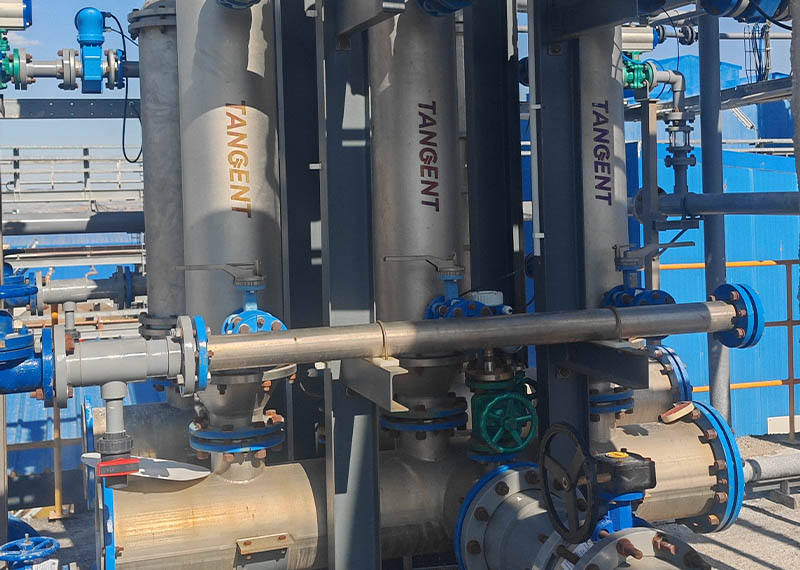
In membrane-cell chlor-alkali production, brine quality has a direct influence on the stability of downstream ion-exchange units and electrolyzers. Raw salt or brine commonly contains calcium, magnesium, iron compounds, clay, suspended solids and other impurities. If these contaminants are not removed effectively, they may increase the load on secondary brine purification and affect the operating cycle of chelating resins and the long-term stability of the membrane electrolysis system.
The basic principle of primary brine purification is to add sodium hydroxide and sodium carbonate to convert dissolved magnesium and calcium ions into insoluble magnesium hydroxide and calcium carbonate precipitates. These solids are then removed through solid-liquid separation.
In this process, ceramic membranes do not directly remove dissolved calcium and magnesium. Their main function is to retain the precipitated solids, suspended particles and other insoluble impurities formed after chemical treatment. The clarified brine then enters the downstream ion-exchange unit for final hardness removal.
A typical process can be summarized as follows:
Raw Brine → Chemical Dosing → Precipitation Reaction → Ceramic Membrane Filtration → Secondary Ion Exchange → Membrane Electrolysis
From an operational perspective, stable membrane flux depends heavily on the quality of the upstream precipitation process. Magnesium hydroxide, in particular, often forms fine, highly hydrated and compressible particles. If chemical dosing is too rapid, mixing is insufficient or reaction time is too short, a large number of fine particles may be generated. These particles can form a dense cake layer on the membrane surface and cause a rapid decline in permeate flux.
Calcium carbonate is generally easier to separate, but uncontrolled supersaturation or poor reaction control may lead to scaling inside tanks, pipelines and membrane channels. For this reason, the performance of a brine purification system cannot be evaluated only by membrane pore size. Chemical dosage, dosing location, pH, mixing intensity, reaction time and solids concentration must all be considered together.
Increasing filtration pressure does not necessarily improve long-term performance. When the deposited solids are compressible, a higher transmembrane pressure may compact the cake layer and increase filtration resistance. Rather than pursuing the highest possible initial flux, it is usually more important to identify a stable operating range that can be maintained and effectively recovered through backwashing and cleaning.
Ceramic membranes are well suited to primary brine purification because of their resistance to high salinity, alkaline conditions, abrasive particles and intensive chemical cleaning. Crossflow filtration, periodic backwashing, concentrate discharge and chemical cleaning can be combined to control solids accumulation and membrane fouling.
From an engineering point of view, however, the ceramic membrane should not be treated as an isolated unit. Its performance is closely connected to upstream precipitation, particle formation, solids discharge and downstream ion exchange. In many cases, unstable flux is not caused by the membrane itself, but by poorly controlled reaction conditions or unsuitable precipitate characteristics.
For this reason, pilot testing with actual brine is highly recommended before full-scale design. Testing can help determine appropriate precipitation conditions, membrane pore size, sustainable flux, backwash frequency and cleaning intervals, providing a more reliable basis for system scale-up.
For primary brine purification in the chlor-alkali industry, the value of ceramic membrane filtration lies not only in producing clarified brine, but also in providing a stable and controllable feed condition for downstream ion exchange and membrane electrolysis.